A 1,000-Stem Spring Installation
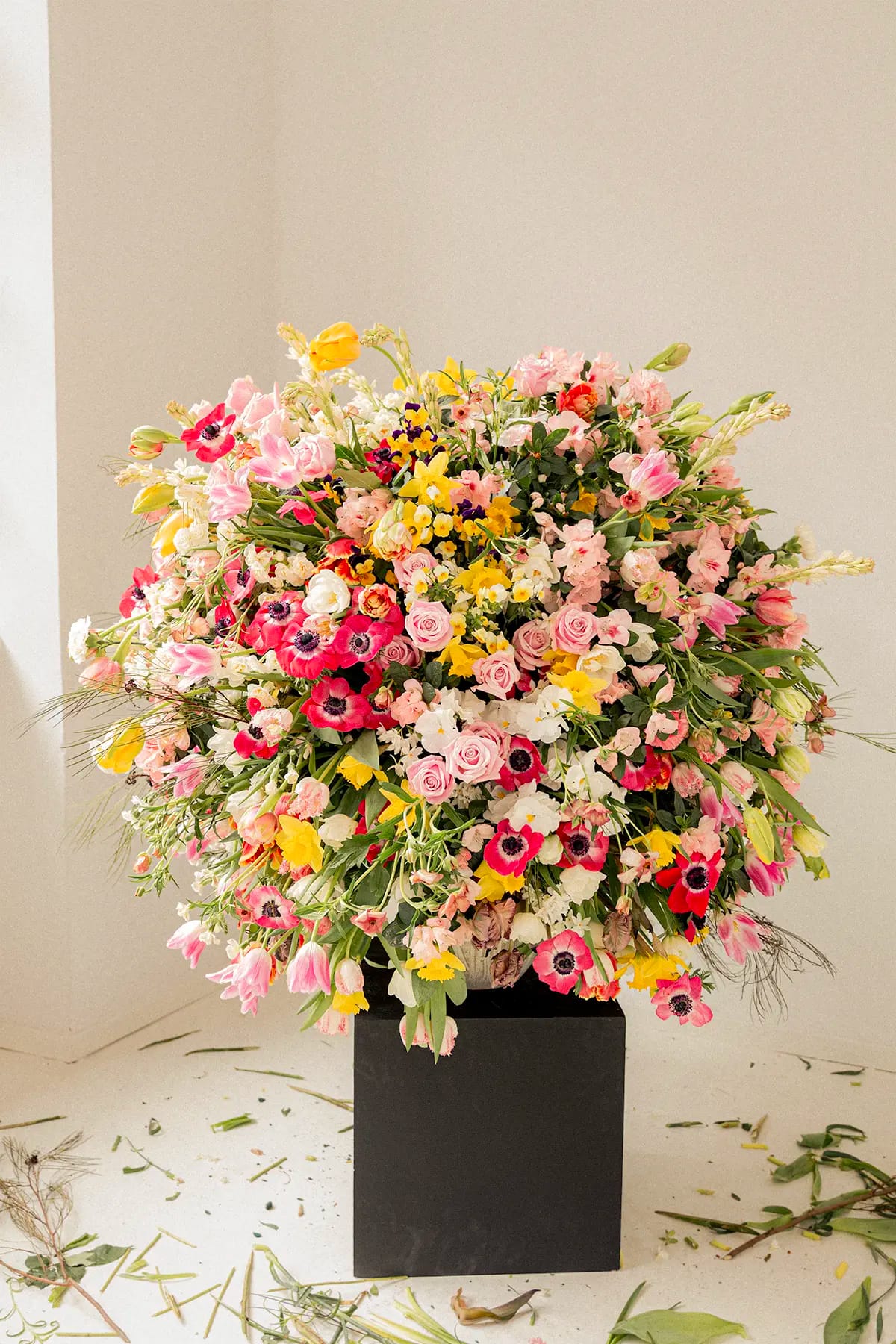
A thousand stems, one large urn, and a single black plinth — that’s what this floral installation came down to. The vessel itself is a large urn-like container, but at this scale it barely reads in the photographs; the flowers take over completely and the urn just does the quiet work of holding the whole thing upright. I built it in my Berlin studio as a set piece for an editorial shoot with sisterMag, and it’s still one of the pieces I get asked about most. It’s also, structurally, exactly how I still work today: dense, oversized, and built stem by stem rather than arranged from a formula.
A Set Piece for an Editorial Shoot
A floral centerpiece that could carry an entire set on its own — something sculptural enough to photograph from every angle, not just a backdrop bouquet. That meant building for scale first: a single mounded form big enough to fill a frame, with no gaps or weak spots, because a set piece has to hold up under studio lighting with nowhere to hide.
What Went Into It: 1,000 Stems of Spring Flowers
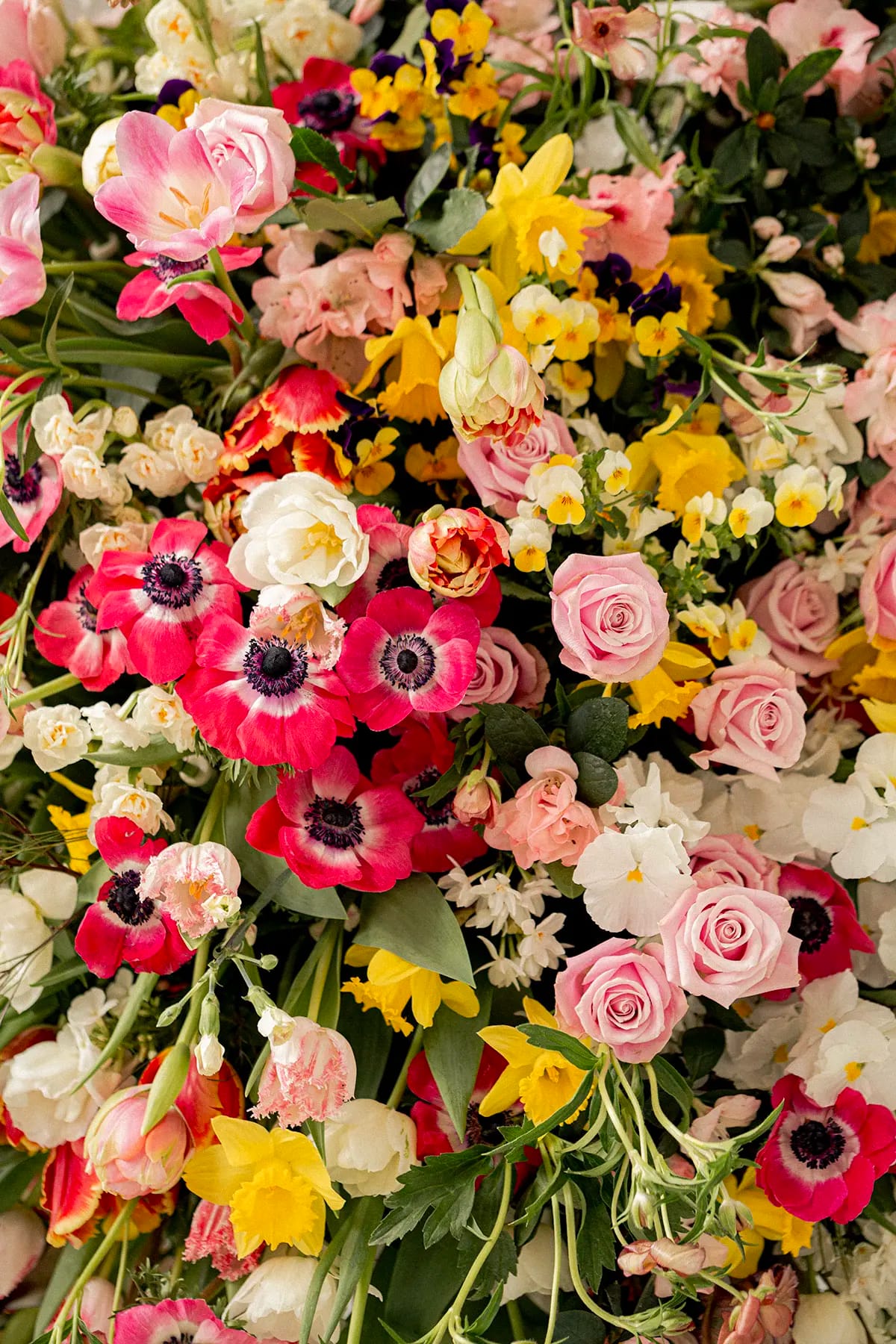
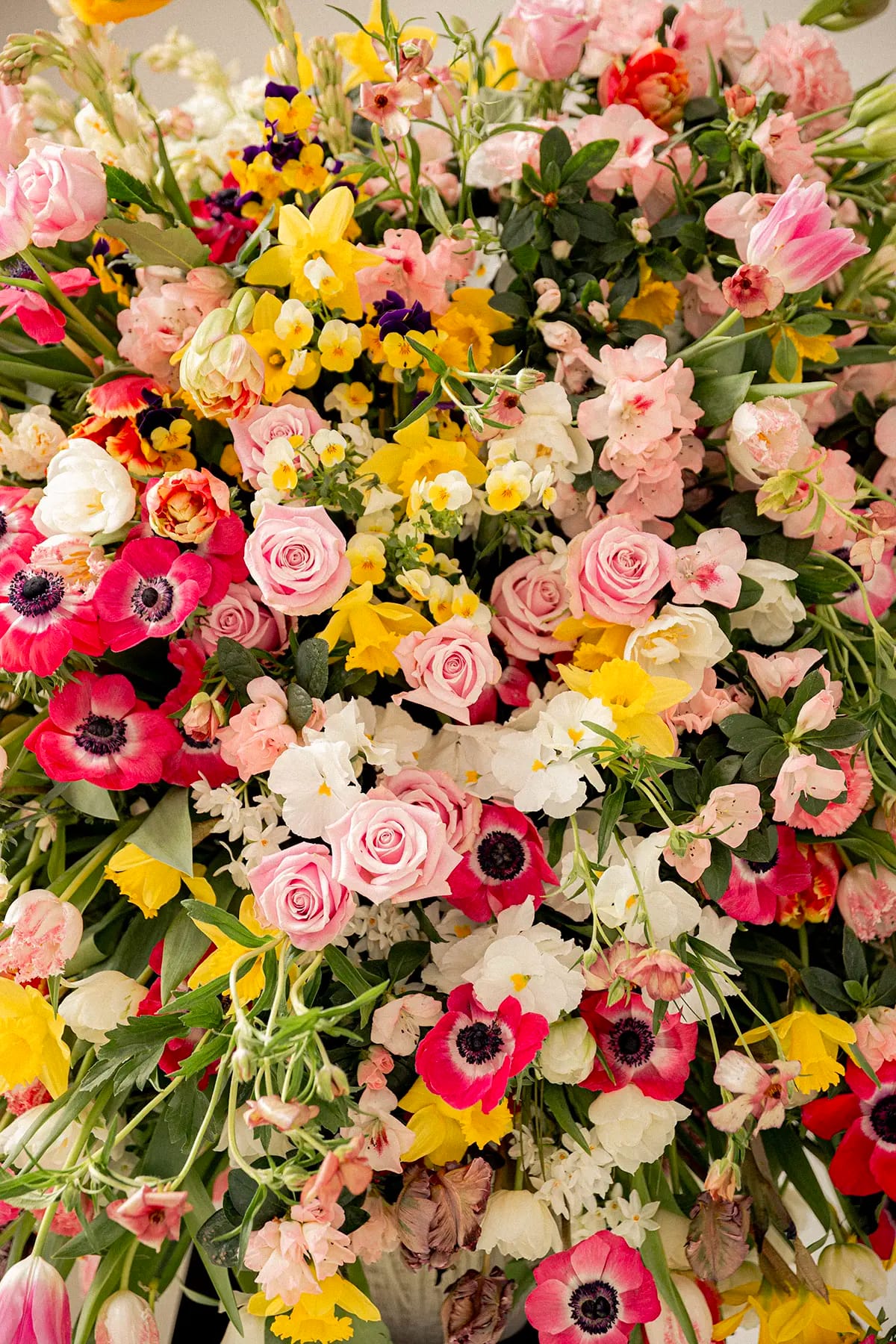
This piece used roughly 1,000 stems, all spring varieties:
- Tulips — several different shapes, mixed to break up any single silhouette
- Anemones — the dark centers do a lot of work visually, giving the mass depth
- Daffodils (Narcissus) — in a few different forms, for scale variation
- Pansies and violas — in various colors, tucked in as the fine detail layer
- Roses — the structural backbone holding the round shape together
Building at this density means working in from a solid base, packing stems tightly enough that the form reads as one continuous surface rather than individual flowers — that’s what gives it the sculptural, almost topiary-like weight in photographs.
Why I’m Adding This to the Journal Now
I built this a few years ago, but it’s not a relic of an earlier style — it’s the same approach I use for installations I’m building today. The scale, the density, the way color and shape are layered rather than arranged: that’s still the throughline in my current work. Putting older work like this in the journal isn’t nostalgia — it’s showing that the practice has range and has held up.
How I Approach a Floral Installation This Size
A few things stay constant whether the piece is for a shoot, a wedding, or a private commission:
- Build for the base first. At this scale, the vessel — often a large urn — is doing structural work even when it disappears under the flowers. A mechanic that can hold 1,000 stems securely matters more than any single flower choice.
- Layer by shape, not just color. Mixing tulip and anemone forms is what keeps a large mass from reading as flat.
- Design for how it will be seen. A set piece for photography gets built differently than an installation meant to be walked around.
If you’re planning a shoot, event, or space in Berlin or beyond that needs something at this scale, I still take on commissions like this — get in touch about a floral installation and let’s talk through what you have in mind.